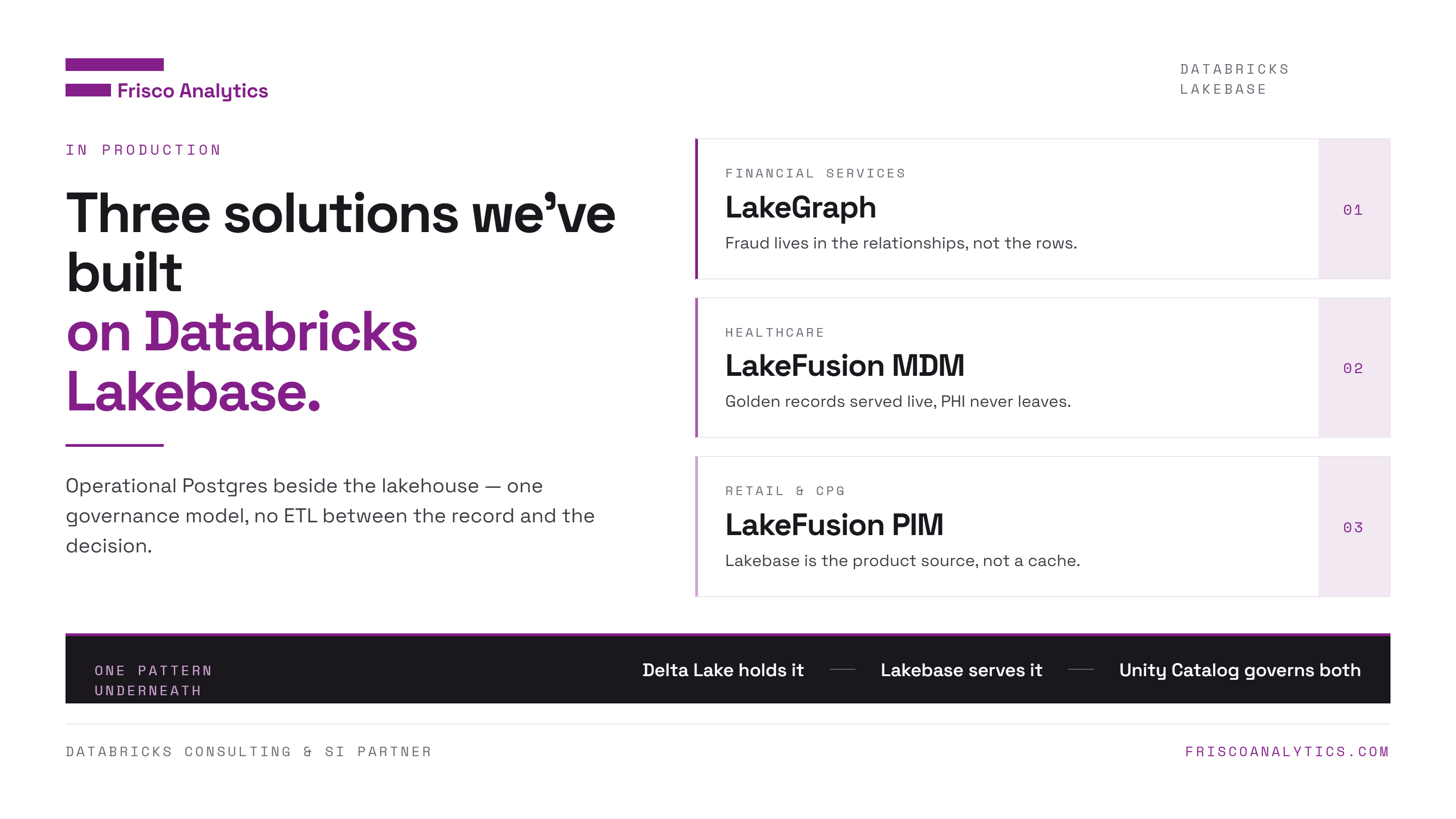
Three production solutions Frisco Analytics has built on Databricks Lakebase, and what they change for financial services, healthcare, and retail.
Every enterprise runs on two truths that rarely agree: what the application knows, and what analytics can see. Between them sits the nightly ETL job — hours of lag, a maintenance burden nobody owns, and two governance models quietly drifting apart.
Databricks Lakebase collapses that divide. A fully managed, PostgreSQL-compatible transactional engine living directly inside the Data Intelligence Platform, governed by the same Unity Catalog that governs your Delta tables. Delta Lake holds the source of truth; Lakebase serves it at operational latency. One platform, one governance model, no pipeline in between.
That's the foundation. But foundations don't win deals — solutions do. At Frisco Analytics we've spent the last year building three of them on Lakebase, and they're now running in production. Here's what they are, and why the pattern matters for the industries we serve.
1 · LakeGraph — when the fraud is in the relationships
Fraud rings, synthetic identities, beneficial-ownership chains — none of these are visible row by row. They're paths, and paths are a graph problem.
LakeGraph turns operational data — transactions, counterparties, contracts, even PDFs — into a governed property graph without moving anything out of the lakehouse. Delta Lake holds the graph's source of truth; Lakebase serves it as Postgres tables with sub-5ms single-hop lookups and sub-second multi-hop traversals, backed by a three-layer cache that keeps repeat queries near-instant.
That latency number is the whole story for financial services. At batch speed, graph analytics is forensics — you find the fraud ring after the money is gone. At sub-5ms per hop, it's a control: score the transaction, walk the network, block the payment, all inside the transaction window. The same traversal pattern moves claims adjudication from days toward minutes and gives wealth-operations agents live household-to-holdings context.
2 · LakeFusion MDM — when the delay is a mismatched identity
Ask anyone who has waited on a prior authorization: the hold-up is rarely the clinical decision. It's the plumbing — a patient recorded three ways, a provider who doesn't match the network file, a location that exists differently in every system.
LakeFusion MDM resolves duplicate, conflicting records from EHR, claims, and reference sources into trusted golden records — Patient 360, Provider 360, Location 360 — entirely inside the governed lakehouse. PHI never leaves. Lakebase then makes those golden records operational, serving them through a low-latency match API at sub-5ms — fast enough that a prior-authorization workflow or point-of-care application can resolve identity in real time instead of overnight.
We've already delivered this pattern in production for a US health network, and the same architecture extends from the location domain to patients, providers, members, and suppliers. Master data used to be where analytics projects went to wait. On Lakebase, it's where operational decisions start.
3 · LakeFusion PIM — when the agent is only as good as the product record
Dynamic pricing agents act in seconds. Stockout detection acts in seconds. A product catalog exported nightly cannot keep up with software that decides by the minute.
LakeFusion PIM is a product information management platform where Lakebase itself is the source of truth: taxonomy management, 1- to 4-tier hierarchy inheritance, live attribute editing, and row-level access control all run natively on Lakebase. Merchandisers edit the data model without an IT ticket, and every downstream channel — e-commerce, marketplaces, pricing engines, shelf-gap agents — syndicates from the same governed record. It ships as a Databricks Marketplace App with zero data egress.
For retail, CPG, and distribution, this closes the last gap in the agentic loop: the AI that reprices a SKU and the storefront that displays it finally read from the same live record.
The pattern underneath all three
Strip away the domain and the architecture is identical:
- Delta Lake holds the source of truth (or, for PIM, the ingestion layer)
- Lakebase serves it — Postgres tables, sub-5ms lookups, branching, scale-to-zero
- Unity Catalog governs both sides with one access model, one lineage graph, one audit trail
- Agents and applications act on live data instead of last night's copy
That last line is the shift. The industry has spent two decades getting very good at describing what happened. Lakebase-native solutions are about deciding what happens next — in the transaction window, at the point of care, on the shelf.
The line between insight and action is disappearing. We're building on it.
Frisco Analytics is a Databricks consulting and SI partner specializing in master data management, graph analytics, and product information management — all delivered natively on the Databricks Data Intelligence Platform. If you want to see LakeGraph, LakeFusion MDM, or LakeFusion PIM against your own data, reach out: contact@friscoanalytics.com · friscoanalytics.com
Further reading from our team:
- The relationships in your data are telling you something — are you listening? (LakeGraph)
- Your master data belongs inside your lakehouse (LakeFusion MDM)
- Your product catalog is lying to you (LakeFusion PIM)